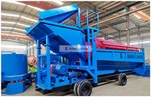
Fixed gold centrifuge supplied for permanent plants: a single unit or a bank of two to four on one frame, with the installation data that decides the layout - footprint, weight, water and power.
A fixed gold centrifuge is the version that is installed and left in place: bolted to a steel frame or a concrete plinth, fed by fixed pipework, and served where it stands. That is the whole difference from a unit that travels with the pit. This page deals with the part that decides whether a fixed machine earns its money - the pad it sits on, the number of units you install, the water and power it is connected to, and how the belt and bowl are reached for maintenance without dismantling the frame.
What a Fixed Installation Changes
The machine itself is the same bowl, belt and fluidised-bed capture. What changes is everything around it - and those are the parts that decide uptime on a permanent plant.
Fixed, not towed
Bolted to a frame
The unit is set on a steel frame or a level concrete plinth and anchored. Rubber damper feet take the bowl vibration out of the structure, so the plinth does not need to be a heavy foundation.
Piped, not hosed
Feed, fluidisation water and concentrate all run on fixed pipework with valves at the machine. Nothing has to be re-laid when the plant is re-started after a shutdown.
Serviced in place
Belt and bowl wear surfaces are reached from the motor side without pulling the unit off its frame. Leave one aisle at least a metre wide on that side and maintenance stays a single-shift job.
1
Installing a Fixed Unit, Step by Step
Pad and footprint. Check the shipping footprint of the model you are installing - it runs from 790×785 mm on the smallest unit to 2,400×2,000 mm on the largest - and prepare a level, drained surface. A fixed plant usually pours concrete; a skid-mounted bank can sit on compacted hard-standing.
Set, level and anchor. Lift by the lugs, level the frame, then bolt it down. Damper feet are fitted under the base, so the bowl vibration is isolated from the plinth rather than transmitted into it.
Feed line. Bring screened undersize from the trommel, or classified mill discharge, to the vertical feed pipe. Feed size is 0–3 mm on the two small models and 0–5 mm on the three larger ones, so oversize is rejected ahead of the machine, not at the centrifuge.
Fluidisation water. This is the one service that must be clean. Screen or settle it before it reaches the bowl: grit blinds the injection holes and the bed never establishes itself. Demand runs from 2–3 m³/h up to 55–80 m³/h across the range, plus the slurry water that carries the feed.
Power. A belt-driven bowl, 0.75–22 kW depending on model, on site power, or a generator sized to the whole plant rather than to this machine.
Product and tails lines. Run the flush manifold to the finishing stage - shaking table or furnace - and the tailings to the settling pond on the same gravity path as the rest of the plant.
Fixed plant on site: feed structure, drum and conveyors on concrete foundations
One unit or a bank. A fixed installation is usually sized as a group, because the clean-up cycle is what limits throughput - not the bowl. Two to four units on one frame let you take one machine offline for flush-out while the rest keep running, which is the practical way to hold a steady feed on a permanent plant. A single unit is the right answer for a pilot line, a small placer operation, or test work on a new deposit where you are still deciding whether the fine gold justifies a plant. Both arrangements use the same frame, damper feet and pipework layout; the difference is how many feed points and flush lines you build.
Installation Data by Model
These are the five numbers an installation is planned around. Selection - capacity, feed density and clean-up cycle - is covered on the Gold Centrifugal Concentrator page, where the full parameter sheet sits.
Installation data
STLB20
STLB30
STLB60
STLB80
STLB100
Shipping weight (kg)
145
400
1,000
1,500
2,000
Shipping footprint (mm)
790×785
1,180×1,140
1,970×1,670
2,300×1,800
2,400×2,000
Motor power (kW)
0.75
1.5
4
11
22
Fluidisation water (m³/h)
2–3
3–5
7–10
30–36
55–80
Feed size (mm)
0–3
0–3
0–5
0–5
0–5
Coarse gold and heavy black sands held on the sluice matting
Site Services the Installation Needs
A level, drained surface under the frame; concrete for a permanent plant, compacted hard-standing for a skid-mounted bank
Clean fluidisation water, screened or settled before it reaches the bowl - grit is the one thing that stops the fluidised layer forming
A settling pond sized for slurry water as well as fluidisation water, not for the fluidisation figure alone
A service aisle on the motor side, at least a metre wide, so the belt and bowl wear surfaces can be changed in place
Spares on site for the two consumables: drive belts and bowl wear surfaces, both supplied for the life of the machine
A feed that has already been screened to the model's top size - oversize is rejected upstream, not at the centrifuge
Fixed Gold Centrifuge FAQ
Q: 1. What is a fixed gold centrifuge?
A: A centrifugal concentrator that is installed and left in place - anchored to a steel frame or concrete plinth, connected to fixed feed, water and product pipework, and maintained where it stands. The bowl, belt drive and gravity-only recovery are the same as any other unit in the range; what defines "fixed" is the installation around it.
Q: 2. How is a fixed installation different from a portable one?
A portable unit travels with the pit and carries everything on its own frame. A fixed installation trades that mobility for three things: pipework instead of hoses, a plinth instead of a tow bar, and space for a service aisle. Where a deposit stays productive season after season, the fixed arrangement is the one that keeps running through a shift change.
Q: 3. Should I install one unit or a bank?
A: A bank of two to four units on one frame is the usual answer for a production plant, because clean-up rather than bowl capacity limits throughput - one unit can be flushed while the others keep working. A single machine suits pilot runs, small placer operations and test work on a new deposit.
Q: 4. How much floor space does it need?
A: Use the shipping footprint as the starting point: 790×785 mm on the STLB20, rising to 2,400×2,000 mm on the STLB100. Then add the service aisle on the motor side and the pipe runs to the feed, water and product connections, which in practice doubles the area of the machine itself.
Q: 5. Does it need a concrete foundation?
A: No heavy foundation. The bowl runs on rubber damper feet under the base, so the vibration is isolated from the structure rather than passed into it. A permanent plant normally pours a level, drained concrete pad; a skid-mounted bank can sit on compacted hard-standing, provided it is level and bolted down.
Q: 6. What water supply does a fixed installation need?
A: Two streams, and they are sized separately: fluidisation water that runs from 2–3 m³/h on the STLB20 to 55–80 m³/h on the STLB100, plus the slurry water that carries the feed. The fluidisation line is the critical one - it must be clean and pressure-stable, and the settling pond has to be sized for both figures added together.
Q: 7. Can it be fed by gravity, or do I need a pump?
A: Either works. Where the trommel or mill sits above the concentrator, gravity feed is simpler and uses the plant you already have. Where the machine is set below the discharge - common in a fixed layout where the pond is close - a slurry pump takes the feed, and feed density is flexible enough (0–50% solids) that no thickener is needed between the two stages.
Q: 8. How are the belt and bowl serviced on a fixed unit?
A: From the motor side, without pulling the machine off its frame - which is why the aisle width matters more than any other layout decision. Drive belts and bowl wear plates are the two consumables, and both stay available for as long as the unit works. Day to day, the checks are feed rate, water pressure and the flush timer.
Q: 9. Can I order a single unit, and how long does delivery take?
A: We accept a single machine as the smallest order. Expect around a fortnight for one unit and about a month for two or three; a bank sized for a full plant is scheduled with you when the order is signed off. Each unit travels on its own steel frame under waterproof cover, with a loading plan drawn for your container.
Q: 10. What information do you need to configure a bank?
A: Give us the tonnage to be treated, the top feed size and the free-gold fraction if you know it, plus what water and power you have. What comes back is a configured bank with named models and an installation layout. Start-up is covered either over video or by a visiting engineer, your team is trained on the actual machines, and the main units carry a 12-month warranty with spares support for their working life.
Give us the tonnage and the top feed size, along with the water and power you have - what comes back is a configured bank with named models and an installation layout.
Zhengzhou Sinolion Machinery Co., Ltd. is one of the most credible manufacturers and suppliers of fixed gold centrifuge in China. Please feel free to buy high quality fixed gold centrifuge for sale here from our factory. Good service and reasonable price are available.