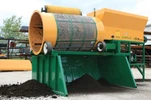


Topsoil Screener
A topsoil screener turns raw excavated ground into saleable graded soil by removing the roots, twigs, stones and debris that make it unsellable. The drum does the work; the mesh fitted to that drum decides what the finished pile looks like.
The WTS series below covers that job across seven models, from a 650 kg machine with an 800 mm drum up to a 2,000 mm production unit. The sections after the table are the ones buyers usually get wrong: screen media, drum angle and moisture.
What a Topsoil Screener Actually Has to Remove
Screening soil with a topsoil screener is not a grading exercise on clean material. The feed is whatever came out of the ground: root balls, twigs, building rubble, construction debris, plastic, wire, and stones in every size class.
Most WTS machines end up on one job in particular: taking raw excavation dirt and turning it into commercial-grade topsoil by pulling out the stones, the root mass, the weeds and the lumps of clay that make it unsellable as it comes out of the ground.
That is why the two questions worth asking first are not "what is the capacity" but "how contaminated is my material" and "how wet is it". Those two answers decide the machine far more than tonnage does.

Topsoil screener removing roots and stones from excavated soil
Screen Media: Woven Mesh or Punch Plate
The drum is only a frame. What does the actual work is the media fitted into it, and this is the single most consequential choice on a topsoil screener.
The drums on every topsoil screener in this range take interchangeable modular screen meshes, so the finished grade is a panel change rather than a new machine.
For landscape-grade topsoil, 18 mm remains the most common aperture, and a properly set-up unit holds contamination in the finished pile below 3%.

Woven mesh drum panel on a topsoil screener set to an 18 mm aperture
For rough feed such as skip waste and demolition debris, woven wire wears out quickly. There we fit punched steel plate drums instead, which trade a little open area for far longer service life against rubble and metal.
Because both formats use the same drum mounting, one topsoil screener can run a mesh drum for soil and compost through the landscaping season, and a punch plate drum when you take on site clearance work.
The WTS Range, Model by Model
Seven models cover the span from a compact yard machine to a production topsoil screener. Drum diameter and length set the throughput; net weight tells you what you need to tow or lift it.
| Model | Drum Ø (mm) | Drum length (mm) | Capacity (ft³/h) | Net weight (kg) | Drum speed (r/min) | Drum angle |
|---|---|---|---|---|---|---|
| WTS0820 | 800 | 2000 | 177-707 | 650 | 16-22 | 0-4° |
| WTS1022 | 1000 | 2200 | 530-1413 | 2,750 | 16-22 | 0-4° |
| WTS1025 | 1000 | 2500 | 530-1413 | 2,900 | 16-22 | 0-4° |
| WTS1230 | 1200 | 3000 | 1060-2473 | 3,210 | 16-22 | 0-4° |
| WTS1560 | 1500 | 6000 | 1413-3887 | 7,200 | 16-22 | 0-4° |
| WTS2050 | 2000 | 5000 | 2120-6184 | 13,600 | 12-16 | 0-4° |
| WTS2055 | 2000 | 5500 | 2120-6184 | 10,560 | 12-16 | 0-4° |
Two details in that table matter more than the capacity column. The smallest unit weighs 650 kg, which is a machine one person can move between jobs. And every model in the range is supplied with a drum cleaning brush - the single most useful item on a soil screener.
Match the Model to the Job
Choosing a topsoil screener for sale comes down to the material and the access, not the brochure. The matrix below is how we narrow it down with a buyer.
| Your situation | Start here | Why |
|---|---|---|
| Garden-scale yard work, tight access, single operator | WTS0820 | 650 kg and an 800 mm drum - it goes where a 2 m unit cannot |
| Landscaping contractor producing saleable topsoil | WTS1022 | The volume step up, still compact enough to tow between sites |
| Screening where the drum needs longer residence time | WTS1025 | Same 1,000 mm diameter as the 1022 on a 2,500 mm drum |
| Council or contractor screening mixed excavated soil | WTS1230 | 1,200 mm drum for volume without a heavy transport footprint |
| Volume topsoil supply, compost or aggregates | WTS1560 | 1,500 × 6,000 mm is the throughput step before the 2 m models |
| High-volume production with a long drum | WTS2050 / 2055 | 2,000 mm diameter, 5,000 or 5,500 mm drum |
Drum Angle, Drum Speed and the Fitted Brush
- Three settings decide how a topsoil screener behaves on the day, and all three are built into the WTS range.
- Drum inclination is adjustable from 0° to 4°. Flatter means material stays in the drum longer and gets more chances to pass the mesh; steeper means it moves through faster.
- On damp ground you flatten the drum rather than accept the throughput a fixed machine would give you.
- Drum speed runs from 16 to 22 r/min on the smaller models and 12 to 16 r/min on the 2,000 mm units. Together with the angle, that is your residence-time control.
- Every model carries a drum cleaning brush as standard. Blinding - particles lodging in the openings until open area collapses - is the main reason a soil screen stops performing, and the brush is the mechanism that prevents it.
Moisture and Feed Method Decide Your Throughput
- The most common disappointment with a topsoil screener is not a machine fault. It is damp material fed too fast into a drum set for dry ground.
- Wet soil blinds a mesh. Particles lodge in the openings, open area drops, and the drum starts carrying material through instead of screening it. On a WTS machine the response is mechanical: flatten the drum angle, keep the cleaning brush working, and slow the feed.
- Feed method matters for the same reason. A machine fed by excavator bucket in surges gets a very different result from the same machine fed steadily. Where the material is moist and fine, a controlled feed rate does more for output than a larger drum would.
Stockpiles, Conveyors and Site Layout
Screen output is only useful if it can be stacked. Compare the transport dimensions with the working dimensions in the table above and the design intent is obvious: a WTS1022 travels at 4,400 × 1,920 mm and works at 4,400 × 4,500 mm.
The extra footprint is the discharge conveyor, which is what lets the machine build stockpiles instead of dropping everything at the drum mouth.
That matters most when the finished soil is the product you are selling. A screener that cannot stack is a machine you shovel out.
A heavy-duty grid option is available over the feed end for sites where oversize rock would otherwise reach the drum.

Discharge conveyor stacking screened topsoil from a topsoil screener
What to Put in Your Enquiry
A topsoil screener enquiry is answered accurately when it arrives with five things. Without them, any quoted capacity is a guess.
The raw material. Topsoil, subsoil, compost, wood chips, skip waste, demolition debris or aggregates - and roughly how contaminated it is.
Purpose of use. De-filtering, grading, granulation, or something else. These point at different screen media.
Capacity. Kilograms or cubic metres per hour, whichever you measure in.
Working hours per day. This sets the duty cycle the drive and the structure have to survive.
Special requirements. Any constraint such as temperature resistance or resistance to a particular medium.
Send those to zzsinolion@163.com and the reply can name the right topsoil screener instead of asking you to choose one.
Questions We Get Asked About Topsoil Screening
Q: What mesh size do I need for topsoil?
A: The WTS drums accept interchangeable modular meshes, and 18 mm is the most common opening for landscape-grade topsoil. It is a changeable panel, not a fixed decision - order the grade your customers buy.
Q: Will it handle wet, sticky soil?
A: It will handle damp soil at reduced throughput, and the WTS range gives you three ways to respond: flatten the drum angle toward 0°, slow the feed, and rely on the fitted cleaning brush to keep the mesh open. Nobody screens saturated clay well with a trommel.
Q: Which model suits a one-man operation?
A: The WTS0820 at 650 kg with an 800 mm drum is the compact option, and the WTS1022 is the usual step up for a contractor working alone with more volume.
Q: What is the difference between the WTS1022 and the WTS1025?
A: The same 1,000 mm drum diameter on a longer drum - 2,200 mm against 2,500 mm. The extra length buys residence time, which is what you want on damp or clayey material.
Q: What should I check on a topsoil screener for sale before I commit?
A: Three things, in this order: the drum diameter in millimetres, the mesh actually fitted to it, and the net weight - because weight decides what you need to tow it with. Capacity figures are secondary to those three.
Q: Woven mesh or punch plate - which do I order?
A: Mesh for soil, compost and wood chips. Punch plate for skip waste, demolition debris and anything with rubble in it. Some buyers order both drums and swap by season - the cheapest way to make one topsoil screener for sale cover two very different contracts.
Q: Does it build its own stockpiles?
A: Yes. The working dimensions are wider than the transport dimensions precisely because the discharge conveyor extends on site, and that is what lets the unit stack material as it screens.
Send Us Your Material and Volume
Tell us what you are screening, roughly how contaminated it is, whether it is dry or damp, and what volume you need per hour.
That is enough to name a model, a drum diameter, a mesh grade and the correct media type before any visit - the difference between a topsoil screener for sale that fits your site and one that fits a brochure.
Zhengzhou Sinolion Machinery Co., Ltd. is one of the most credible manufacturers and suppliers of topsoil screener in China. Please feel free to buy high quality topsoil screener for sale here from our factory. Good service and reasonable price are available.
Hot Tags: topsoil screener, China, manufacturers, suppliers, factory, price, for sale, Sand Trommel Screen, Trommel Screener, HOT Compost Trommel Screen, Gold Washing Plant, Heavy Duty Trommel Screen, Briquettes Drying Machine