

High-capacity soil screening rarely fails from a lack of engine power; it fails when equipment cannot withstand sticky clay, uneven bucket loads, or remote sites with zero mains electricity.
Recently, our manufacturing facility completed the inspection, container stuffing, and maritime dispatch of a custom-engineered WTS1230 Mobile Trommel Screen bound for a prominent quarrying and civil earthworks contractor in the Czech Republic. Operating across stone extraction pits, soil relocation zones, and earthwork filling sites, the client required a rugged, fully autonomous screening plant capable of processing 60 m³ of mixed excavation spoil and topsoil per hour-sorting unrefined site dirt into certified, marketable soil and aggregate fractions for local resale.
Here is the engineering journey, the communication timeline, and the technical breakdown behind this high-efficiency European delivery.
1. The Czech Client's Core Challenge: Turning Waste Soil into Resale Revenue
The Czech client is an established civil contractor handling hundreds of thousands of cubic meters of quarry overburden, mixed subsoil, and demolition earthwork annually. In Central Europe's increasingly strict circular-economy framework, disposing of excavation soil into landfills incurs heavy dumping fees and escalating transport penalties. Conversely, clean, classified topsoil and aggregate sub-base command premium prices in commercial landscaping and construction backfilling.
However, their operating conditions posed three major roadblocks:
- No Grid Electricity on Site: The primary sorting depot and expansion pits are located in remote quarry outskirts and temporary remediation zones with zero electrical grid connection.
- Moisture & Blinding Risks: Central European excavated soil carries significant moisture and clay content, which rapidly clogs and blinds standard flat vibrating screens.
- Strict Hourly Throughput Target: The machine had to sustain 60 m³/h as a steady 10-hour working average (totaling roughly 600 m³ per day), matching the cycle time of their 2.5 m³ wheel loaders without bogging down.
2. The Consultation Journey: Why WTS1230 Was the Exact Engineering Fit
During initial technical exchanges, the client originally inquired about our compact WTS1022 model (1000 mm × 2200 mm drum, rated at 15–40 m³/h). After examining the client's feed composition-comprising heavy topsoil, mixed river rock, and construction spoil-our application engineers pointed out a critical operational reality:
"Running a 40 m³/h rated screener at its absolute ceiling to squeeze out 60 m³/h causes screen flooding, poor separation sharpness, and premature mechanical wear. True industrial profitability requires running comfortably in the machine's median operational band."
We recommended the WTS1230 Mobile Trommel Screen, configured specifically for their site parameters:
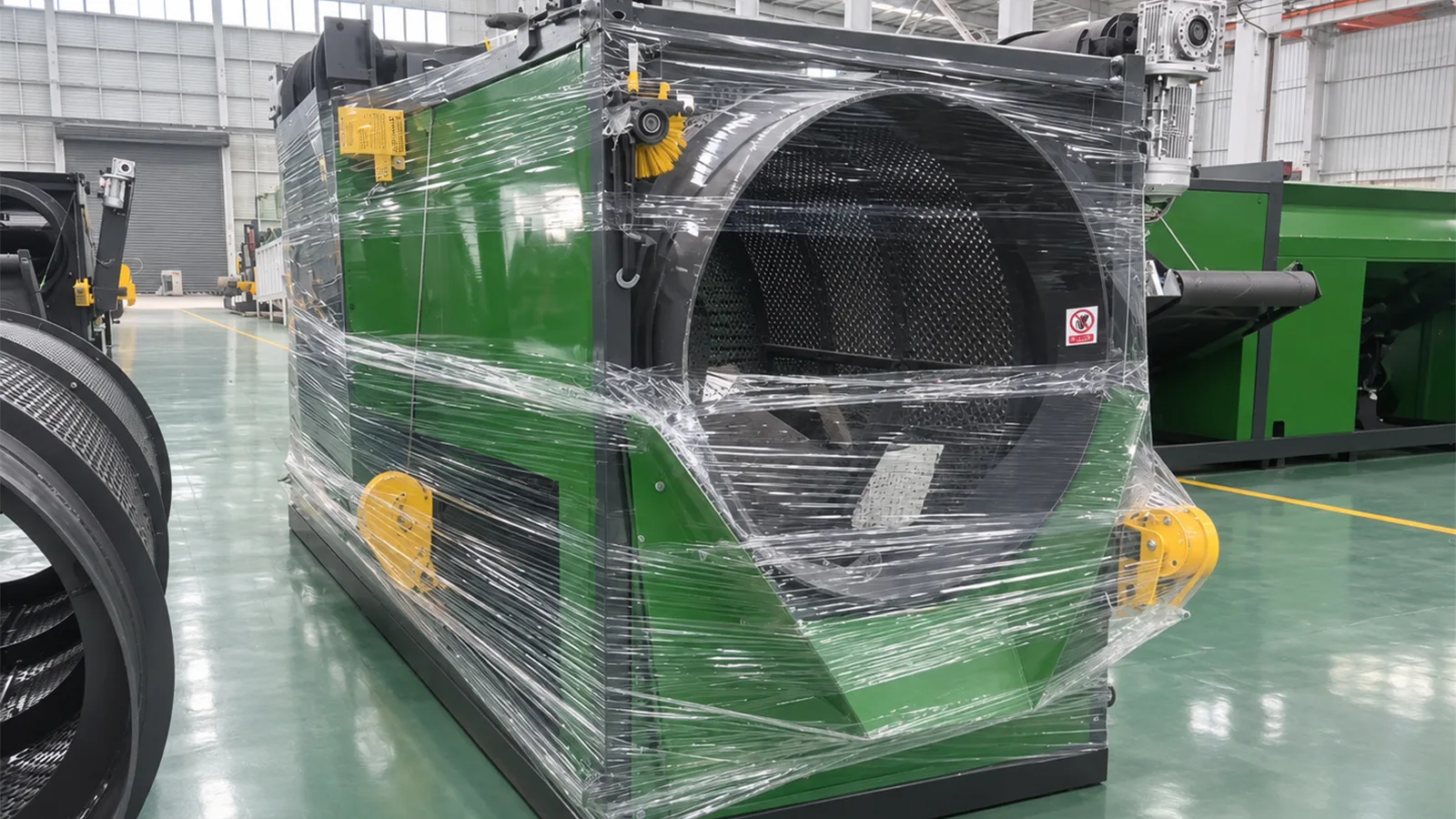
- Generous 9.6 m² Effective Screening Area: With a 1200 mm barrel diameter and 3000 mm effective length, material enjoys ample rotational residence time. Fine topsoil falls cleanly through apertures rather than riding out with coarse aggregate.
- Wide Loading Hopper (2290 mm × 1520 mm, volume approx. 1.42 m³): Designed with steep side angles and a mechanical feeder to swallow entire loader bucket dumps without material bridging.
- Mid-Band Rating (30–70 m³/h): Operating at 60 m³/h keeps the mechanical drives, bearings, and belts at a smooth 85% operating load, ensuring consistent throughput across multi-shift projects.
3. Custom Engineering: Diesel Power, Anti-Clogging & 3-Fraction Output
To meet European site regulations and independent field operation, we implemented three dedicated engineering upgrades for this build:
Integrated Soft-Start Control for Diesel Generator Supply Because the Czech site relies entirely on a mobile diesel genset, electrical surges during startup can trip generator breakers or cause severe voltage drops. We integrated a customized ABB frequency conversion control cabinet with built-in soft-start logic. This reduces startup inrush current by over 60%, allowing the diesel generator to idle efficiently while giving operators precise variable-speed control over drum rotation to adapt to wet or dry soil.
- 3-Fraction Separation in a Single Pass To maximize resale profitability, the client needed more than a basic scalping screen. The Czech WTS1230 was fitted with two foldable side discharge conveyors plus one reinforced tail conveyor. In a single continuous operation, the plant produces:
- Fine Grade (e.g., 0–15 mm): High-fertility screened topsoil for municipal parks and garden landscaping resale.
- Middle Grade (e.g., 15–40 mm): Clean drainage gravel and structural sub-base fill for road engineering.
- Oversize (>40 mm): Heavy rock, root debris, and concrete rubble separated cleanly for primary crushing or backfill disposal.
- Continuous Nylon Rotary Cleaning Brushes Damp soil is notorious for blinding screen meshes. A continuous, high-wear nylon rotary cleaning brush is mounted across the top of the barrel, automatically sweeping the apertures clean on every rotation-preventing clay buildup without interrupting feed.

4. Verified Technical Specifications (WTS1230 Czech Build)
- Model: WTS1230 Mobile Trommel Screen
- Rated Hourly Capacity: 30 – 70 m³/h (Client Design Target: 60 m³/h)
- Trommel Drum Diameter: 1200 mm
- Trommel Drum Length: 3000 mm
- Effective Screening Area: Approx. 9.6 m²
- Mesh Aperture Range: 2 mm – 80 mm (Interchangeable screen sections)
- Feed Hopper Dimensions: 2290 mm (L) × 1520 mm (W), Volume ≈ 1.42 m³
- Discharge Arrangement: 2 Foldable Side Conveyors (3 Fractions output)
- Drive System: Electric motor with Hardened Gear Reducer & ABB VFD Control Cabinet
- Power Source: Client's On-Site Diesel Generator Set (Off-grid configuration)
- Anti-Blinding System: High-density nylon flocking continuous rotary brushes
- Transport Dimensions (L × W × H): 5855 mm × 1800 mm × 2255 mm
- Total Machine Mass: Approx. 4200 kg
5. Factory Inspection, Container Loading & Dispatch
Before dispatch, the machine underwent an 8-hour continuous dry-run test at our manufacturing plant, verifying bearing temperatures, conveyor tracking, and soft-start inverter harmonics under simulated diesel load.
For international transport:
- Auxiliary side discharge belts were folded, detached, and wrapped in multi-layer protective industrial film.
- The main mobile chassis was safely wheeled into the shipping container using high-capacity cranes and specialized forklifts.
- The entire assembly was cross-braced with high-tensile steel wire tensioners, wheel chocks, and anti-corrosion safeguards to guarantee absolute stability across maritime and European rail routes.

6. The Business Impact: Realizing Circular Profit in Soil Management
By classifying mixed soil and quarry overburden on-site with the WTS1230, the Czech contractor secures an immediate double economic gain:
1. Eliminating Haulage Waste: Screening material directly at the excavation or quarry site eliminates the cost of trucking unsorted raw dirt to fixed third-party treatment plants.
2. Creating Two Commercial Revenue Streams: High-purity topsoil is bagged or sold in bulk to landscaping firms, while screened gravel is diverted straight into municipal roadbed projects.
With equipment commissioned and parts backed by our comprehensive 1-year global warranty and lifetime online engineering support, this WTS1230 unit will become a core revenue generator across the client's earthmoving operations.