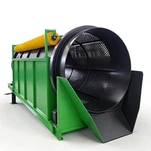


On September 30, 2026, a WTS1230 mobile trommel screen completed its factory run-in and left our Zhengzhou workshop for a soil recycling client in the Czech Republic. The numbers that shaped the order are 60 m³/h and roughly 600 m³ a day. The number that shaped the machine is zero: there is no mains power on site. This screening plant is built to run the whole process - drum, conveyors and control cabinet - from the client's own diesel generator set.

The numbers first: what "60 m³/h, 600 m³ a day" actually requires
Sixty cubic metres an hour is a sustained figure, not a peak one. Over a ten-hour working day it adds up to the 600 m³ the client needed - which turns this from a spec-sheet question into a system question: can the machine hold that rate all day, and can everything around it keep up?
Three things decide that on soil:
- Screening surface and residence time. Throughput in a trommel is governed by how much open area the material passes over and how long it stays on it. The WTS1230 runs a 1200 × 3000 mm drum with about 9.6 m² of screening surface - against roughly 4.83 m² on the smaller WTS1022 in the same series. More open area and a longer path mean the fines actually get their chance to fall through before the material reaches the discharge end, instead of being carried out with the oversize.
- Feed control. A 2290 × 1520 mm hopper opening lets a wheeled loader charge the drum in a single pass, and the feed mechanism is adjustable, so the drum is neither starved nor flooded. Across a ten-hour day, an uneven feed is one of the most common reasons a plant falls short of its rated rate.
- Drum speed versus material. The WTS1230 has a variable-speed drum drive. Dry soil and wet soil want different settings: faster rotation moves more material along, slower rotation gives damp, sticky soil more time on the mesh. That one adjustment is what lets a 30–70 m³/h machine hold 60 m³/h across a real stockpile instead of in a demonstration.
60 m³/h sits inside the WTS1230's rated band of 30–70 m³/h depending on material - and that is the point worth reading twice. It is an ordinary working figure for this machine on soil, not a claim made at the edge of what the machine can do.
There is no grid connection. Here is how the plant runs anyway
On an off-grid site, screening equipment stops being a machine question and becomes a power question. Three things have to line up: the generator set has to be able to start the plant, run it at a steady load, and burn as little fuel as possible while doing it.
- One power entry, not five. The drum drive and the discharge conveyors are all electrically driven and fed from a single variable-frequency control cabinet. From the generator set's point of view there is one cable run and one load - not a scatter of separate motors and starters. That is exactly what you want when the power source is a diesel set rather than a substation.
- Starting is the hard part, not running. The heaviest moment for any generator set is the instant a loaded drum begins to turn. Variable-frequency control gives the drive a soft start, so the starting surge is spread out instead of arriving as one spike - and the set can be sized for the running load rather than for a shock it only sees once a shift.
- Fuel burn follows the setting. Because drum speed is adjustable, the operator tunes the machine to the material rather than running it flat out. On dry, free-flowing soil there is no reason to burn fuel for speed the material does not need; on damp soil the extra time on the mesh is precisely what protects the throughput.

There is a second off-grid saving here that has nothing to do with fuel. At 5855 × 1800 × 2255 mm in transport configuration and approximately 4200 kg, the WTS1230 travels on its own wheeled chassis behind a standard truck. On a site with no power line, the alternative is usually a fixed plant somewhere else - which means hauling soil out and hauling products back. Moving the plant instead of the material removes most of those truck movements, and it removes them permanently, not just for one season.
Requirement communication: the site survey that set this WTS1230's configuration
Soil screening has fewer variables than most applications - but the handful that matter all change the machine. This is what we worked through with the client, in the order the answers arrived.
Asked 01 · What exactly are you screening?
- Confirmed Soil - topsoil for landscaping, plus mixed excavated material coming back from site work.
- What it fixed: a trommel is the right tool - no washing or attrition stage is needed. What changes with the feed is the mesh and the settings, not the type of machine.
Asked 02 · What output do you need per hour, and per day?
- Confirmed 60 m³/h; about 600 m³ across a working day.
- What it fixed: the WTS1230 rather than the smaller WTS1022. At 60 m³/h the machine sits mid-band inside its 30–70 m³/h rating, so it works inside its comfort zone all day instead of at its ceiling.
Asked 03 · What power is available where the machine will work?
- Confirmed No mains connection. The site runs on a diesel generator set.
- What it fixed: the whole electrical side of the order - an electrically driven machine with one variable-frequency control cabinet and soft start, so the generator set sees a single load instead of several.
Asked 04 · Will the machine stay on one site?
- Confirmed The specification is the mobile WTS1230.
- What it fixed: the wheeled towable chassis - 5855 × 1800 × 2255 mm in transport, approximately 4200 kg, towed behind a standard truck.
Asked 05 · Where do the three products go?
- To confirm Which fractions are sold on and which are reused on site.
- What it decides: mesh apertures and which fractions the side conveyors and tail conveyor carry. Two side conveyors plus one tail conveyor mean the split is set to the client's grades, not to a factory default.
Asked 06 · How wet does the soil get through the season?
- To confirm The moisture range across the working season.
- What it decides: the starting mesh and the drum-speed starting point. Damp clay is the case that needs the most time on the mesh, and the adjustable drum speed is how that time is bought.
Two items are still open on our side. Neither changes the machine - they change the mesh and the settings, which is exactly why they are worth resolving before the drum is commissioned rather than after.
Confirmed configuration
- Drum 1200 × 3000 mm with ≈9.6 m² of screening surface - sized for a sustained 60 m³/h, not a peak
- Rated 30–70 m³/h depending on material - the 60 m³/h target sits mid-band
- Variable-speed drum drive - one setting to trade speed against residence time as soil moisture changes
- Electrically driven, with a single variable-frequency control cabinet and soft start - configured to run from the client's diesel generator set
- Interchangeable mesh from 2 mm to 80 mm - set to the client's topsoil specification
- Three-fraction discharge: two foldable side conveyors plus one tail conveyor
- Wheeled towable chassis, 5855 × 1800 × 2255 mm, approximately 4200 kg
Three fractions in one pass - and why that matters on soil
Soil rarely has a single destination. The fines go to landscaping or back into planting beds; a mid-grade goes to structural fill or sub-base; and the stones, roots and rubble have to leave the process somewhere. Screening soil into one pile and sorting it afterwards does not remove that work - it just moves it downstream, where it costs loader hours and stockpile space.
The WTS1230 discharges three streams in a single pass: two foldable side conveyors and a tail conveyor. The mesh is interchangeable from 2 mm up to 80 mm and the drum can be configured with a single or double screen, so the cut points are set to the client's own product grades rather than to a standard drum.
The damp-soil problem. Anyone who has screened soil in a wet month knows the failure mode - and it is not a shortage of power. It is apertures blinded by sticky material, which quietly converts a 60 m³/h machine into a 30 m³/h machine without any alarm going off. Two features address it directly: an adjustable drum speed, so wet soil gets more time on the mesh, and rotating cleaning brushes that keep the apertures open while the drum turns. Slower drum plus actively cleaned mesh is what stops a wet week becoming a lost week.

What 600 m³ a day looks like on site
The machine is one link in a chain. A 600 m³ day is roughly ten hours at 60 m³/h, which means the loading, the stockpiling and the hauling around the plant all have to work at that same rate - and on an off-grid site, so does the fuel supply.
- Feeding. The loader cycle has to deliver soil at the average rate the drum can take it. A buffer stockpile beside the hopper is what absorbs the difference between a smooth loader cycle and a stop-start one.
- Stockpiling. Three fractions means three stockpiles with room to grow. The side conveyors fold out to place material clear of the chassis - the difference between a stockpile you can pick up with a loader and one you have to work around.
- Hauling. This is the strongest argument for a mobile plant. Every cubic metre screened on site is a cubic metre that never has to be trucked to a fixed plant and back. How much that saves depends entirely on your haul distance - which is why it tends to matter most on exactly the kind of remote site that has no power line in the first place.
- Fuel. Off-grid means diesel is part of the production plan rather than a utility bill that arrives weeks later. Plan the refuelling cycle around the shift pattern, not around the tank gauge.

The machine is not the constraint. Rated 30–70 m³/h, the WTS1230 covers the 60 m³/h target with room to spare - which is why holding 600 m³ a day is really a question of keeping the loader cycle at 60 m³/h.
WTS1230: specification as configured
| Parameter | WTS1230 |
|---|---|
| Production capacity | 30–70 m³/h depending on material - 60 m³/h is the target on this project |
| Trommel diameter | 1200 mm |
| Trommel length | 3000 mm |
| Screening area | approximately 9.6 m² |
| Outer meshes from | 2 – 80 mm, interchangeable |
| Feed hopper | 2290 × 1520 mm |
| Transport dimensions | 5855 × 1800 × 2255 mm |
| Weight | approximately 4200 kg |
| Drum drive | Variable speed, electrically driven |
| Power source on this project | Client's on-site diesel generator set - no grid connection |
| Discharge | Two foldable side conveyors plus one tail conveyor - three fractions in one pass |
| Mobility | Wheeled towable chassis |
The same series continues below and above this machine: the WTS0820 (800 × 2000 mm) and WTS1022 (1000 × 2200 mm) for smaller soil volumes, and the WTS1560 (1500 × 6000 mm drum, approximately 23.1 m² of screening surface, up to 110 m³/h) where a single machine has to keep up with a larger earthworks programme. Full details are on the WTS1230 mobile trommel screen page.

Frequently asked questions
Q: Can the WTS1230 really screen 60 m³/h of soil?
A: Yes - and on this machine it is a middle-of-the-range figure rather than a limit. The WTS1230 is rated at 30–70 m³/h depending on material, on a 1200 × 3000 mm drum with about 9.6 m² of screening surface. Soil is one of the easier feeds because it does not require washing or attrition; what moves the number up or down within that band is moisture, the mesh aperture you fit, and how evenly the hopper is fed.
Q: What size diesel generator set does a WTS1230 need?
A: The rating has to be matched to two things, not one: the machine's connected running load, and the starting profile of the drum drive. The starting moment is the demanding one, which is why variable-frequency control with a soft start matters on an off-grid site - it spreads the surge out, so the generator set can be sized for the running load instead of for a spike it meets once a shift. We confirm the generator set rating against the delivered machine's connected load and starting profile before dispatch.
Q: Will wet soil blind the drum and kill the throughput?
A: Wet, sticky soil is the hardest case there is for a trommel, and blinding - not a lack of power - is the usual cause of lost throughput. Two features work against it on the WTS1230: the drum speed is adjustable, so the operator can give damp material a longer residence time on the mesh, and rotating cleaning brushes keep the apertures open while the drum turns. You will still slow down in a wet week; the point is that you keep screening through it.
Q: How many material grades can it produce in one pass?
A: Three. Two foldable side conveyors plus one tail conveyor discharge three separate fractions simultaneously, so soil goes out as a fine fraction, a mid-grade and an oversize stream without a second machine or a second handling stage. The drum can be specified with a single or double screen, which is what sets where those two cut points fall.
Q: What mesh apertures are available for soil?
A: The WTS1230 uses interchangeable mesh from 2 mm up to 80 mm. For topsoil the upper cut is normally decided by the specification the finished product has to meet, not by the machine, so we set the mesh around the client's own product grade. Because the mesh is interchangeable, a change in specification later is a screen change rather than a machine change.
Q: Can it be moved between sites?
A: Yes - it is a mobile machine by design. Transport configuration is 5855 × 1800 × 2255 mm at approximately 4200 kg, on a wheeled towable chassis that follows a standard truck, and the side conveyors fold in for the move. That mobility is what makes on-site screening economic: the plant travels to the material instead of the material travelling to the plant.
Q: How is a 600 m³ day actually reached?
A: It is arithmetic plus discipline: a ten-hour working day at a sustained 60 m³/h is about 600 m³. In practice the machine is rarely the constraint. The number holds when the loader cycle keeps the hopper fed at the average rate, when there is stockpile room for three fractions, and when diesel resupply is planned around the shift rather than around the tank gauge.
Q: What support comes with the machine?
A: Every trommel screening machine we build is manufactured in-house, and we provide repair services together with 24/7 spare parts support. For a machine working off-grid in a different country, the practical questions are wear-part availability and response time, so those are worth settling at order stage rather than after commissioning.
Four numbers we need to size a soil screening plant
We size the plant around your site rather than around the brochure - which is exactly how this WTS1230 was specified. Send us four things, and you will get back a concrete proposal: machine model, mesh, generator set rating and price.
1. Material - what you are screening, and what has to come out of it.
2. Output - the cubic metres per hour you need, and the hours in a working day.
3. Power - grid connection, generator set, or neither yet.
4. Site - fixed installation or mobile, and the ground conditions it has to work on.
Zhengzhou Sinolion Machinery Co., Ltd. designs and builds trommel screening equipment and mineral processing plants in Zhengzhou, China, with all fabrication kept in-house. Working without a grid is a normal starting point for us rather than an exception - quarries, land restoration schemes, remote earthworks and recycling yards account for a large share of the machines we ship. Bring us the four numbers above - material, output, power and site - and we will engineer the plant around them.